







How herbs can help Osteoporosis and Osteopenia
What is osteoporosis?
Osteoporosis is a bone disease that develops without any telltale symptoms and hence is known as a “silent disease,” which weakens the bones, rendering them brittle and prone to imminent fractures.
Osteoporosis mostly affects men after the age of 65, while it is more common in women after menopause due to the hormone changes, especially for Asian women with lower level of estrogen.
According to Traditional Chinese Medicine (TCM), what causes osteoporosis?
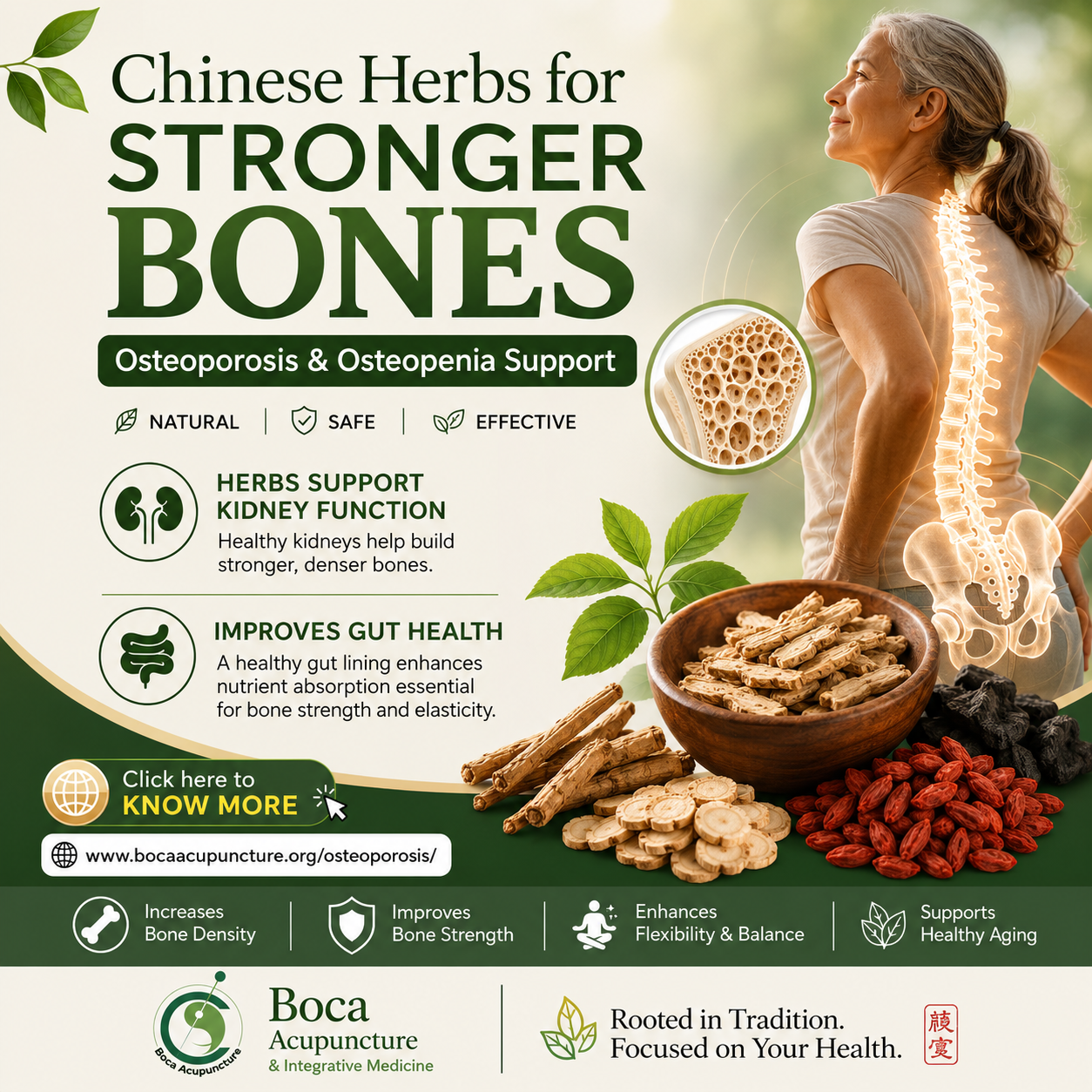
Kidney deficiency is the primary factor that causes osteoporosis. Kidneys store essence that transform into bone marrow, which nourishes bones and ligaments.
The other contributing factor is the deficiency in liver and spleen, alongside blood stasis, which acts as the core pathological mechanism, depriving nutrients, vital energy, Qi, and blood flow to the bones. People with inflammation in their gut and blood vessels tend to have deficiency in Kidney essence, which nourish the bone.
What is the treatment available for osteoporosis?
Traditional medicine treats osteoporosis using reaction-prone medications like bisphosphonates, along with supplements and lifestyle changes, which overwhelms the patients with financial and practical burdens on many patients. The fosamax can increase the bone density, but not the bone elasticity.
As a result, a large number of patients have started to opt for holistic, drug-free treatment options such as herbal therapy, which also improves patients’ mental health and overall wellness.
Among the alternative and complementary holistic approach that is gaining resounding acceptance is TCM’s herbal therapy to strengthen kidneys to prevent osteoporosis, offered by well-known holistic wellness centers such as Boca acupuncture clinics in Boca Raton. Boca clinic has a team of specialist to help patient prevent the osteoporosis through acupuncture, herbal formula and life style changes.
What is TCM’s botanical therapy protocol to rid the kidneys of its deficiencies?
Chinese medicine does not consider kidney deficiencies as a single disease to be treated with a few herbs and their formulations. Rather it treats this affliction using individualized syndrome differentiation called Bian Zheng Lun Zhi, which help restoring the balance of Yin and Yang, Qi and Essence (Jing) when combined with dietary and lifestyle changes.
These diverse Chinese herbal remedies are formulated to prevent osteoporosis, which are divided into three groups according to the beneficial effects: 1) Restore the kidney Ying and Yang balance that strengthens kidney essence (Jing) 2) Invigorate the spleen, which augments Qi and blood to nourish the bone, and 3) Attenuate blood stasis and reinstate adequate flow of blood and Qi.
How do herbs strengthen kidney functions and prevent osteoporosis?
Certain herbs help kidney with weak essence by supplying it with active phytochemicals that target the biological drivers of kidney disease by reducing oxidative stress, lowering inflammation, and limiting tissue scarring (fibrosis).
The three primary Chinese herbs used to tone up the kidney and prevent osteoporosis include Drynariae Rhizoma (Gu Sui Bu), Epimedii Folium (Yin Yang Huo), and Psoraleae Fructus (Bu Gu Zhi). These botanicals contain active phytochemicals that promote the formation of bone-building cells called osteoblasts and inhibiting bone-resorbing cells called osteoclasts, help produce bone marrow and slow down bone ageing.
Kidney- strengthening (tonifying) herbs can do the following job in the body:
1) Replenish kidney essence (jing), which in turn strengthens the skeletal structure.
2) Revitalizes warm kidney Yang, the internal warmth and metabolic functions needed to reach nutrients to the bones—removes blood stasis.
3) Improves bone marrow production, which optimizes bone density, leading to stronger bones.
Herbs are known to promote bone-building activity, heal their microstructures, and stop easy breakdown by optimizing osteoclast activities to preserve bone mineral density.
Numerous studies, meta-analyses, peer-reviewed research papers, and systematic reviews collectively suggest that multi-herb TCM and other formulations, including phytochemicals, help improve bone health.
However, in conclusion, it can be said that, due to limited evidential outcomes, herbal therapies cannot be considered as a viable replacement for traditional medicine treatment for osteoporosis.
Nevertheless, its efficacy as a complementary alternative treatment, Chinese herbal formulas are beyond doubt, that they help restoration of kidney essence (Jing) and improve absorption of vitamins and minerals, which leads to stronger bones with increase elasticity. Healthy bones need optimized density and elasticity to prevent the fracture.
References:
1) John Cunningham 1, Stuart M Sprague, Jorge Cannata-Andia, et al. Osteoporosis in chronic kidney disease. DOI: 10.1053/j.ajkd.2003.12.004. PMID: 14981616.
2) Ping-Chung Leung, Wing-Sum Siu. Herbal Treatment for Osteoporosis: A Current Review. DOI: 10.4103/2225-4110.110407. PMID: 24716161.
3) Su-Juan Wang, Wei Yue, Khalid Rahman, Hai-Liang Xin, et al. Mechanism of Treatment of Kidney Deficiency and Osteoporosis is Similar by Traditional Chinese Medicine. DOI: 10.2174/1381612822666151112150346. PMID: 26561071